A blue rectangular tablet marked “B707” is supposed to be a 2 mg alprazolam tablet. In April 2026, however, the Center for Forensic Science Research and Education’s NPS Discovery program reported finding ethylflualprazolam in a blue B707 tablet submitted from Georgia. The same tablet also contained 4′-Cl deschloroalprazolam, another novel benzodiazepine structurally related to alprazolam. …
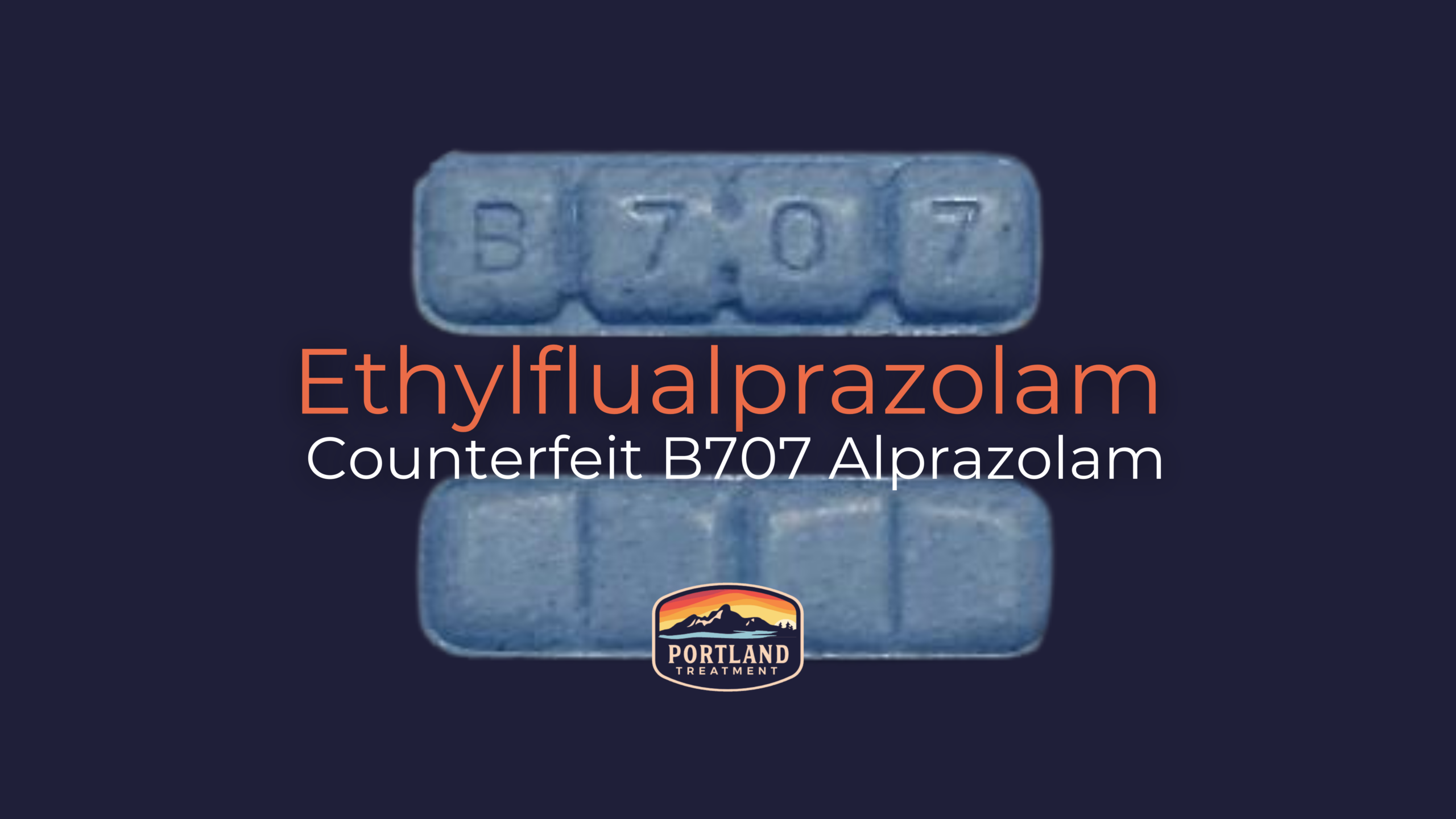

A blue rectangular tablet marked “B707” is supposed to be a 2 mg alprazolam tablet. In April 2026, however, the Center for Forensic Science Research and Education’s NPS Discovery program reported finding ethylflualprazolam in a blue B707 tablet submitted from Georgia. The same tablet also contained 4′-Cl deschloroalprazolam, another novel benzodiazepine structurally related to alprazolam.
This is an important early warning, but it should be interpreted carefully. At the time of its report, CFSRE had detected ethylflualprazolam in only one drug-material sample and had not found it in its toxicology specimens. One confirmed tablet does not mean every blue B707 pill is counterfeit, nor does it prove that the substance is widespread across the United States or currently circulating in Maine.
What the discovery does show is that an imprint, shape, and color are no longer enough to verify what an unregulated pill contains.
What Was Found in the Blue B707 Tablet?
CFSRE received the tablet on April 6, 2026, and published its ethylflualprazolam monograph on April 28. The sample was described as a rectangular blue tablet labeled “B707” that originated in Georgia. Laboratory analysis identified ethylflualprazolam alongside 4′-Cl deschloroalprazolam.
The identification was not based on a visual inspection or basic test strip. Researchers used gas chromatography-mass spectrometry and liquid chromatography quadrupole time-of-flight mass spectrometry, comparing the results with an ethylflualprazolam reference standard.
The public monograph did not provide a dose, concentration, or reliable alprazolam-equivalent strength for the tablet. Therefore, it cannot be assumed that the pill would behave like a legitimate 2 mg alprazolam tablet.
What Is a B707 Pill Supposed to Contain?
According to the official DailyMed labeling, a legitimate B707 tablet is a light-blue-to-blue rectangular tablet containing 2 mg of alprazolam. It has three break lines on one side, two notches between the lines, and the B707 imprint on the other side.
Alprazolam is the generic medication commonly associated with the brand name Xanax. However, B707 is a generic alprazolam imprint rather than an imprint for brand-name Xanax.
A pill dispensed directly by a licensed pharmacy in its labeled container is different from a tablet purchased through an unregulated seller. Counterfeit pill manufacturers can reproduce legitimate-looking colors, shapes, score lines, and imprints. The CDC has documented counterfeit pills made to resemble alprazolam and other prescription medications while containing fentanyl, illicit benzodiazepines, or other unexpected drugs.
Alprazolam 2 mg at a Glance
| Category | What We Know |
|---|---|
| Medication name | Alprazolam |
| Common brand name | Xanax |
| Tablet imprint | B707 |
| Strength | 2 mg |
| Drug class | Prescription benzodiazepine |
| Tablet appearance | Light-blue to blue rectangular tablet with the imprint “B707” |
| Approved uses | Treatment of anxiety disorders and panic disorder |
| How it works | Enhances the activity of GABA, a neurotransmitter that slows activity in the central nervous system |
| Typical effects | Reduced anxiety, relaxation, drowsiness, slowed reaction time and impaired coordination |
| Onset | Generally considered relatively fast-acting |
| Prescription status | Schedule IV controlled substance in the United States |
| Dependence risk | Regular use can cause tolerance, physical dependence and withdrawal |
| Withdrawal risk | Abrupt discontinuation may cause severe anxiety, insomnia, tremors, hallucinations or seizures |
| Major interaction risk | Combining alprazolam with opioids, alcohol or other sedatives can cause profound sedation, respiratory depression, coma or death |
| Can naloxone reverse it? | No. Naloxone does not reverse alprazolam, but it should be given when opioid exposure may also be involved |
| Counterfeit-pill concern | Unregulated tablets marked B707 may contain designer benzodiazepines, fentanyl or other unexpected substances |
| Can appearance confirm authenticity? | No. Only medication dispensed by a licensed pharmacy in its original labeled container should be considered verified |
| Key takeaway | A legitimate B707 tablet contains 2 mg of alprazolam, but the imprint alone cannot confirm the contents of a pill obtained outside a pharmacy |
What Is Ethylflualprazolam?
Ethylflualprazolam is a novel benzodiazepine, sometimes called a designer benzodiazepine or designer benzo. CFSRE classifies it as a triazolobenzodiazepine that is structurally similar to flualprazolam and alprazolam.
There is currently very little published information about its human pharmacology, potency, onset, duration, metabolism, or toxic dose. Researchers have hypothesized that it may have activity similar to flualprazolam, but that does not provide a reliable way to predict how a particular tablet will affect someone. Toronto’s Drug Checking Service has likewise reported that its strength and duration remain unknown.
This means there is no dependable conversion such as “one ethylflualprazolam pill equals a certain amount of Xanax.” The amount in an unregulated tablet may also vary from one pill or batch to the next.
Ethylflualprazolam at a Glance
| Category | What We Know |
|---|---|
| Drug name | Ethylflualprazolam |
| Drug class | Novel or “designer” benzodiazepine |
| Chemical family | Triazolobenzodiazepine |
| Related substances | Structurally related to flualprazolam and alprazolam |
| Approved medical use | None currently recognized in the United States |
| Known U.S. detection | Identified in April 2026 in a blue rectangular tablet marked “B707” submitted from Georgia |
| Other substance in the tablet | 4′-Cl deschloroalprazolam, another novel benzodiazepine |
| Expected tablet contents | The B707 imprint is normally associated with 2 mg alprazolam |
| Known potency | Not established; no reliable alprazolam-equivalent dose is available |
| Known duration | Not established |
| Likely effects | Sedation, impaired coordination, memory loss, slowed thinking, confusion, and reduced consciousness |
| Major overdose risk | Severe central nervous system depression, especially when combined with opioids, alcohol, or other sedatives |
| Can naloxone reverse it? | No. Naloxone only reverses opioid effects, but it should still be given when fentanyl or another opioid may be present |
| Detected by fentanyl test strips? | No. Fentanyl test strips do not identify ethylflualprazolam |
| Detected on routine drug tests? | Not reliably; expanded laboratory testing may be required |
| Withdrawal concern | Regular benzodiazepine use can cause physical dependence, and abrupt discontinuation may trigger severe withdrawal or seizures |
| Key takeaway | A pill’s color, shape, or imprint cannot confirm its contents when it comes from an unregulated source |
What Is 4′-Cl Deschloroalprazolam?
The second substance CFSRE found in the blue B707 tablet, 4′-Cl deschloroalprazolam, is also classified as a novel benzodiazepine and central nervous system depressant. It is structurally similar to alprazolam and is an alprazolam isomer, meaning the compounds share the same molecular formula but have different chemical arrangements. Specialized laboratory analysis may be needed to distinguish between them.
Novel benzodiazepines have been associated with adverse events and fatalities, particularly when used with opioids, alcohol, or other depressants. Finding two different novel benzodiazepines in one tablet adds another layer of uncertainty because the person taking it may have no way of knowing the strength or combined effects.
4′-Cl Deschloroalprazolam at a Glance
| Category | What We Know |
|---|---|
| Drug name | 4′-Cl deschloroalprazolam |
| Other name | 4′-chloro deschloroalprazolam |
| Drug class | Novel or “designer” benzodiazepine |
| Chemical family | Triazolobenzodiazepine |
| Relationship to alprazolam | It is an isomer of alprazolam, meaning both substances have the same molecular formula but a different chemical arrangement |
| Approved medical use | None currently recognized in the United States |
| First CFSRE report date | December 7, 2022 |
| Recent detection | Found alongside ethylflualprazolam in a blue rectangular tablet marked “B707” submitted from Georgia in April 2026 |
| Expected B707 contents | A legitimate B707 tablet contains 2 mg of alprazolam |
| Known potency | Not reliably established |
| Known onset and duration | Not adequately established through controlled human research |
| Likely effects | Sedation, impaired coordination, slowed thinking, memory loss, confusion and reduced consciousness |
| Major overdose risk | Severe central nervous system depression, particularly when combined with opioids, alcohol or other sedatives |
| Can naloxone reverse it? | No. Naloxone does not reverse benzodiazepines, although it should still be administered when opioid exposure may be involved |
| Detected by fentanyl test strips? | No. Fentanyl test strips cannot identify 4′-Cl deschloroalprazolam |
| Detected on routine drug tests? | Not reliably. It may be confused with alprazolam or missed unless specialized laboratory methods are used |
| Forensic testing challenge | Its chemical similarity to alprazolam can complicate identification, although laboratories can distinguish the substances through unique mass-spectral fragments |
| Dependence and withdrawal risk | As a benzodiazepine-class substance, repeated use may cause physical dependence. Abrupt discontinuation could potentially cause severe withdrawal, including seizures |
| Key takeaway | A tablet that looks like pharmaceutical alprazolam may contain this unapproved designer benzodiazepine, another drug or a combination of substances |
Ethylflualprazolam Has Appeared in More Than One Drug Market
The Georgia B707 tablet was not the first recent international signal involving ethylflualprazolam.
December 2025 — Toronto: Toronto’s Drug Checking Service first detected ethylflualprazolam on December 16, 2025. During that reporting period, it was found in three samples that people expected to contain fentanyl. The service reported that the compound’s strength and duration were unknown.
March 2026 — Australia: CanTEST identified ethylflualprazolam in two bar-shaped pills expected to contain alprazolam. One was a yellow R039 tablet, and the other was a white tablet marked “XANAX” and “02.” Neither sample contained alprazolam, and the alert described this as Australia’s first reported detection of ethylflualprazolam.
April 2026 — United States: CFSRE reported the compound in the blue B707 tablet from Georgia, together with 4′-Cl deschloroalprazolam.
Together, these reports suggest that ethylflualprazolam is beginning to appear in different parts of the unregulated drug supply and in more than one form. They do not, however, provide enough information to estimate how common the substance is.
Why Are Designer Benzodiazepines Dangerous?
Potency and Duration May Be Unknown
Prescription alprazolam has established manufacturing standards and labeled doses. An unregulated designer benzo does not. Even when two pills look identical, the amount and combination of active substances may be different.
Ethylflualprazolam has too little available human data to predict exactly how quickly it will take effect, how strongly it will affect someone, or how long impairment may last. Benzodiazepines can vary considerably in potency, onset, and duration.
The Tablet May Contain Multiple Depressants
The reported B707 tablet contained two novel benzodiazepines. Other counterfeit tablets may contain opioids, additional benzodiazepines, or entirely different substances.
Combining benzodiazepines with opioids or alcohol can cause profound sedation, respiratory depression, coma, and death. A person may unknowingly combine depressants simply because the tablet’s actual ingredients do not match what they expected.
A Convincing Imprint Can Create False Reassurance
A blue color, rectangular shape, score lines, and B707 imprint do not authenticate a pill obtained outside a pharmacy. Counterfeit pharmaceuticals can look highly convincing, and visual inspection cannot determine which drug—or how much of it—is present.
Possible Effects of Ethylflualprazolam
Because direct human data on ethylflualprazolam remain limited, its complete effect profile is not known. Based on its drug class and reports involving related benzodiazepines, possible effects may include:
- Significant drowsiness or difficulty staying awake
- Dizziness and impaired balance
- Slurred speech or slowed thinking
- Poor coordination
- Confusion or memory loss
- Reduced consciousness
- Slowed or impaired breathing, particularly when other depressants are involved
International health alerts have specifically associated benzodiazepines with drowsiness, dizziness, memory loss, impaired coordination, and potentially fatal respiratory depression.
Signs of a Possible Overdose
Treat the situation as an emergency when someone:
- Cannot be awakened or does not respond
- Has slow, shallow, irregular, or stopped breathing
- Makes gurgling, choking, or unusual snoring sounds while unresponsive
- Has blue, gray, or unusually pale lips or fingertips
- Collapses, has a seizure, or loses consciousness
- Vomits while deeply sedated
- Becomes severely confused or unable to stand
Do not assume the person simply needs to “sleep it off.” Counterfeit pills can involve more than one depressant, and the substances involved may not be known when emergency symptoms begin.
What Should You Do If Someone Took a Suspected Counterfeit B707 Pill?
- Call 911 immediately if the person cannot be awakened, is breathing abnormally, has collapsed, or is experiencing another severe reaction.
- Give naloxone when opioid exposure is possible. Counterfeit tablets may contain fentanyl or another opioid even when they are sold as benzodiazepines. Naloxone can reverse an opioid component but will not reverse ethylflualprazolam or other benzodiazepine effects. Emergency care is still necessary even when the person initially responds to naloxone.
- Keep the person on their side and monitor their breathing. Provide rescue breathing or CPR when needed and when you are trained to do so.
- Stay with the person until emergency help arrives. Do not leave an unresponsive person alone or allow them to remain flat on their back.
Can Fentanyl Test Strips Detect Ethylflualprazolam?
No. Fentanyl test strips are intended to detect fentanyl and certain related substances. They do not identify ethylflualprazolam, 4′-Cl deschloroalprazolam, or every other substance that may be present in a counterfeit pill.
A negative fentanyl test therefore does not authenticate a B707 tablet or prove that it is pharmaceutical alprazolam. The CDC also cautions that a negative result does not guarantee that a drug is free of every potent fentanyl-like compound.
Can Routine Drug Tests Detect Designer Benzodiazepines?
Not always. Some designer benzodiazepines may react with routine benzodiazepine screening tests, while others may create confusing discrepancies between an initial screen and a confirmatory panel.
Research involving emergency-department specimens found that traditional confirmation panels designed around prescribed benzodiazepines may fail to confirm designer benzodiazepines unless the laboratory uses expanded or high-resolution testing.
Someone receiving emergency care should tell clinicians about the pill’s appearance, imprint, expected contents, source, and any other substances that may have been taken. A routine test result should not outweigh serious symptoms or a credible history of exposure.
Do Not Abruptly Stop Regular Benzodiazepine Use
People who have been taking pills sold as Xanax or alprazolam regularly may develop physical dependence without knowing which benzodiazepine they are actually taking.
For benzodiazepines as a drug class, physical dependence can develop even when medication is taken as prescribed. Abruptly stopping or reducing the dose too rapidly can cause serious withdrawal reactions, including potentially life-threatening seizures.
Possible benzodiazepine withdrawal symptoms include severe anxiety, tremors, insomnia, agitation, confusion, hallucinations, increased heart rate, and seizures. A person taking B707 tablets or other unregulated benzodiazepines regularly should receive a medical evaluation rather than attempting to stop suddenly without professional guidance.
What Does the B707 Alert Mean for People in Maine?
The tablet in the CFSRE report came from Georgia, not Maine. The report should therefore not be presented as proof that ethylflualprazolam has become widespread in Portland, Biddeford, or elsewhere in the state.
It is still relevant to people in Maine because it demonstrates how closely an unregulated tablet can imitate a legitimate alprazolam product. The safest assumption is that a pill obtained outside a licensed pharmacy cannot be authenticated by its imprint, color, packaging, or the seller’s description. The CDC recommends taking only medications that were prescribed and warns that pills purchased illegally may contain highly potent or unexpected drugs.
Treatment for Benzodiazepine Use in Maine
Someone may need professional help when they are:
- Taking alprazolam more than prescribed or other benzodiazepines every day
- Needing more pills to feel the same effect
- Experiencing anxiety, shaking, sweating, or insomnia between doses
- Using pills to prevent withdrawal rather than for their original effect
- Having blackouts or unexplained memory gaps
- Combining benzodiazepines with opioids or alcohol
- Unable to stop despite repeated attempts
- Buying pills outside a licensed pharmacy
- Unsure what is actually in the pills they have been taking
Portland Treatment provides intensive outpatient and partial hospitalization services for people affected by benzodiazepine dependence and substance use. Portland Treatment does not operate an onsite medical detox unit. When medically supervised withdrawal is necessary, the admissions team can help coordinate a referral to a qualified detox or inpatient provider and continue treatment through PHP or IOP once the person is medically stable.
Call 855-449-7674 to speak with Portland Treatment about benzodiazepine use, treatment options, or insurance coverage. In an overdose or severe withdrawal emergency, call 911 before contacting an admissions program.
Frequently Asked Questions
Is a B707 pill Xanax?

A legitimate B707 tablet is a generic 2 mg alprazolam tablet. Alprazolam is the medication sold under the brand name Xanax, but B707 is a generic imprint rather than a brand-name Xanax imprint.
Does this report mean every blue B707 pill is counterfeit?
No. The CFSRE report concerned one drug-material sample from Georgia. Legitimate B707 alprazolam tablets continue to exist. The concern applies primarily to pills obtained outside a licensed pharmacy, where the appearance and imprint cannot verify the contents.
Is ethylflualprazolam stronger than alprazolam?
Its comparative strength is not yet known. CFSRE reported very little available pharmacological or potency data, and drug-checking programs have described its strength and duration as unknown.
Was fentanyl found in the reported blue B707 tablet?
CFSRE’s public monograph identified ethylflualprazolam and 4′-Cl deschloroalprazolam in the sample. Fentanyl was not identified as the primary finding in that report. That does not mean other counterfeit B707 tablets are fentanyl-free or that the same ingredients will be present in every tablet.
Will naloxone reverse an ethylflualprazolam overdose?
Naloxone does not reverse benzodiazepine effects. It should still be administered when opioid exposure is possible because the pill may also contain fentanyl or another opioid. Call 911 and continue monitoring the person even after naloxone is administered.
Sources
Center for Forensic Science Research and Education. (2026, April 28). Ethylflualprazolam: NPS Discovery new drug monograph.
https://www.cfsre.org/images/monographs/Ethylflualprazolam-New-Drug-Monograph-NPS-Discovery.pdf
Center for Forensic Science Research and Education. (2022, December 7). 4′-Cl-deschloroalprazolam.
https://www.cfsre.org/nps-discovery/monographs/4cl-deschloroalprazolam
National Library of Medicine. (n.d.). Alprazolam tablet—B707 product labeling. DailyMed.
https://dailymed.nlm.nih.gov/dailymed/lookup.cfm?setid=a5428249-48c5-4489-bf0b-80ab586277da
Centers for Disease Control and Prevention. (2023). Drug overdose deaths with evidence of counterfeit pill use—United States, July 2019–December 2021.
https://www.cdc.gov/mmwr/volumes/72/wr/mm7235a3.htm
Toronto’s Drug Checking Service. (2025, December 26). 126 samples checked: December 13–26, 2025.
https://drugchecking.community/report/december-13-26-2025/
The Know. (2026, March 27). Ethylflualprazolam found in expected “alprazolam” pills.
https://theknow.org.au/alerts_warnings/ethylflualprazolam-found-in-expected-alprazolam-pills/
Puzyrenko, A., Wang, D., Schneider, R., Wallace, G., Schreiber, S., Brandt, K., & Gunsolus, I. L. (2022). Urine drug screening in the era of designer benzodiazepines: Comparison of three immunoassay platforms, LC-QTOF-MS and LC-MS-MS. Journal of Analytical Toxicology, 46(7), 712–718.
https://academic.oup.com/jat/article/46/7/712/6374717
U.S. Food and Drug Administration. (2020). FDA requiring boxed warning updated to improve safe use of benzodiazepine drug class.
https://www.fda.gov/drugs/fda-drug-safety-podcasts/fda-requiring-boxed-warning-updated-improve-safe-use-benzodiazepine-drug-class
Centers for Disease Control and Prevention. (2024). Fentanyl facts.
https://www.cdc.gov/stop-overdose/caring/fentanyl-facts.html
Substance Abuse and Mental Health Services Administration. (n.d.). Opioid overdose reversal medications.
https://www.samhsa.gov/substance-use/treatment/overdose-prevention/opioid-overdose-reversal